


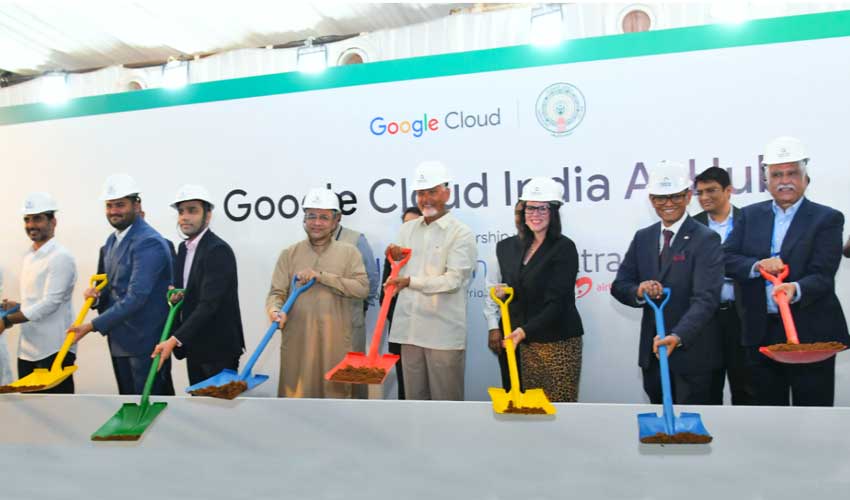
Google has officially broken ground on its largest-ever artificial intelligence (AI) hub in India, marking a major milestone in the country’s digital infrastructure journey and reinforcing its vision of a “Viksit Bharat.”

According to the press release, The groundbreaking ceremony, celebrated together with AdaniConneX and Nxtra by Airtel, took place at Tarluvada, Andhra Pradesh, with key dignitaries: Shri Ashwini Vaishnaw, Hon’ble Minister for Railways, Information & Broadcasting and Electronics & Information Technology, Government of India; Shri Nara Chandrababu Naidu, Hon’ble Chief Minister of Andhra Pradesh; Shri Nara Lokesh, Hon’ble Minister for Information Technology, Electronics and Communications, RTG and HRD, Government of Andhra Pradesh; Shri Bikash Koley, Vice President, Google Cloud; Shri Karan Adani, Director, Adani Group; Shri Jeet Adani, Director, Adani Group; and Shri Rakesh Mittal, Vice Chairman, Bharti Enterprises.
Google’s $15 billion investment over five years (2026-2030) to establish a comprehensive AI ecosystem in India, designed to be an important contributor to the government’s Viksit Bharat 2047 vision.
First announced in October 2025, this project includes India’s first gigawatt-scale AI hub comprising three data center campuses. AdaniConnex and Nxtra by Airtel will lead the construction of the data center buildings and connecting infrastructure, enabling Google to deploy advanced AI capabilities and scale digital services across India.
The AI hub also comprises the America-India Connect initiative for an expanded fiber-optic network; and a long-term clean energy strategy that prioritizes bringing new clean energy supply to the electricity grid, accelerating India’s national goal of reaching 500 GW of non-fossil fuel capacity by 2030.
The AI hub will deliver the high-performance, low-latency services that businesses and organizations need to build and scale their own AI-powered solutions, accelerate research and development, and ultimately help India secure its place as a global leader in the AI-driven future.
The groundbreaking ceremony was accompanied by the Bharat AI Shakti Conclave, a first-of-its-kind conference organized in strategic partnership with the Government of Andhra Pradesh and the Hon’ble Minister Shri Nara Lokesh. The Conclave served as a unique platform for convening suppliers, industry partners, and infrastructure stakeholders to explore how to translate and accelerate Google's anchor investment into a tangible economic value chain for the region.
Themed 'Collaborating to Deliver India's AI Corridor,' the Conclave reflects a deliberate industrial strategy: Google's investment in Visakhapatnam is designed not only to build world-class infrastructure, but to catalyze a broader technology ecosystem that multiplies the benefits to the local economy. From prioritizing a local-first procurement approach for vital infrastructure activities, to integrating local small and medium enterprises (SMEs) under Google's global safety and operational frameworks, the project aims to facilitate capacity building and effectively raise the competitiveness of regional industry players for future large-scale infrastructure work.
ADVERTISEMENT
According to the press release, The groundbreaking ceremony, celebrated together with AdaniConneX and Nxtra by Airtel, took place at Tarluvada, Andhra Pradesh, with key dignitaries: Shri Ashwini Vaishnaw, Hon’ble Minister for Railways, Information & Broadcasting and Electronics & Information Technology, Government of India; Shri Nara Chandrababu Naidu, Hon’ble Chief Minister of Andhra Pradesh; Shri Nara Lokesh, Hon’ble Minister for Information Technology, Electronics and Communications, RTG and HRD, Government of Andhra Pradesh; Shri Bikash Koley, Vice President, Google Cloud; Shri Karan Adani, Director, Adani Group; Shri Jeet Adani, Director, Adani Group; and Shri Rakesh Mittal, Vice Chairman, Bharti Enterprises.
Google’s $15 billion investment over five years (2026-2030) to establish a comprehensive AI ecosystem in India, designed to be an important contributor to the government’s Viksit Bharat 2047 vision.
ADVERTISEMENT
First announced in October 2025, this project includes India’s first gigawatt-scale AI hub comprising three data center campuses. AdaniConnex and Nxtra by Airtel will lead the construction of the data center buildings and connecting infrastructure, enabling Google to deploy advanced AI capabilities and scale digital services across India.
The AI hub also comprises the America-India Connect initiative for an expanded fiber-optic network; and a long-term clean energy strategy that prioritizes bringing new clean energy supply to the electricity grid, accelerating India’s national goal of reaching 500 GW of non-fossil fuel capacity by 2030.
ADVERTISEMENT
The AI hub will deliver the high-performance, low-latency services that businesses and organizations need to build and scale their own AI-powered solutions, accelerate research and development, and ultimately help India secure its place as a global leader in the AI-driven future.
The groundbreaking ceremony was accompanied by the Bharat AI Shakti Conclave, a first-of-its-kind conference organized in strategic partnership with the Government of Andhra Pradesh and the Hon’ble Minister Shri Nara Lokesh. The Conclave served as a unique platform for convening suppliers, industry partners, and infrastructure stakeholders to explore how to translate and accelerate Google's anchor investment into a tangible economic value chain for the region.
ADVERTISEMENT
Themed 'Collaborating to Deliver India's AI Corridor,' the Conclave reflects a deliberate industrial strategy: Google's investment in Visakhapatnam is designed not only to build world-class infrastructure, but to catalyze a broader technology ecosystem that multiplies the benefits to the local economy. From prioritizing a local-first procurement approach for vital infrastructure activities, to integrating local small and medium enterprises (SMEs) under Google's global safety and operational frameworks, the project aims to facilitate capacity building and effectively raise the competitiveness of regional industry players for future large-scale infrastructure work.
This news/story/article has not been written/edited by World Media Organization and is sourced from a syndicated feed.

